

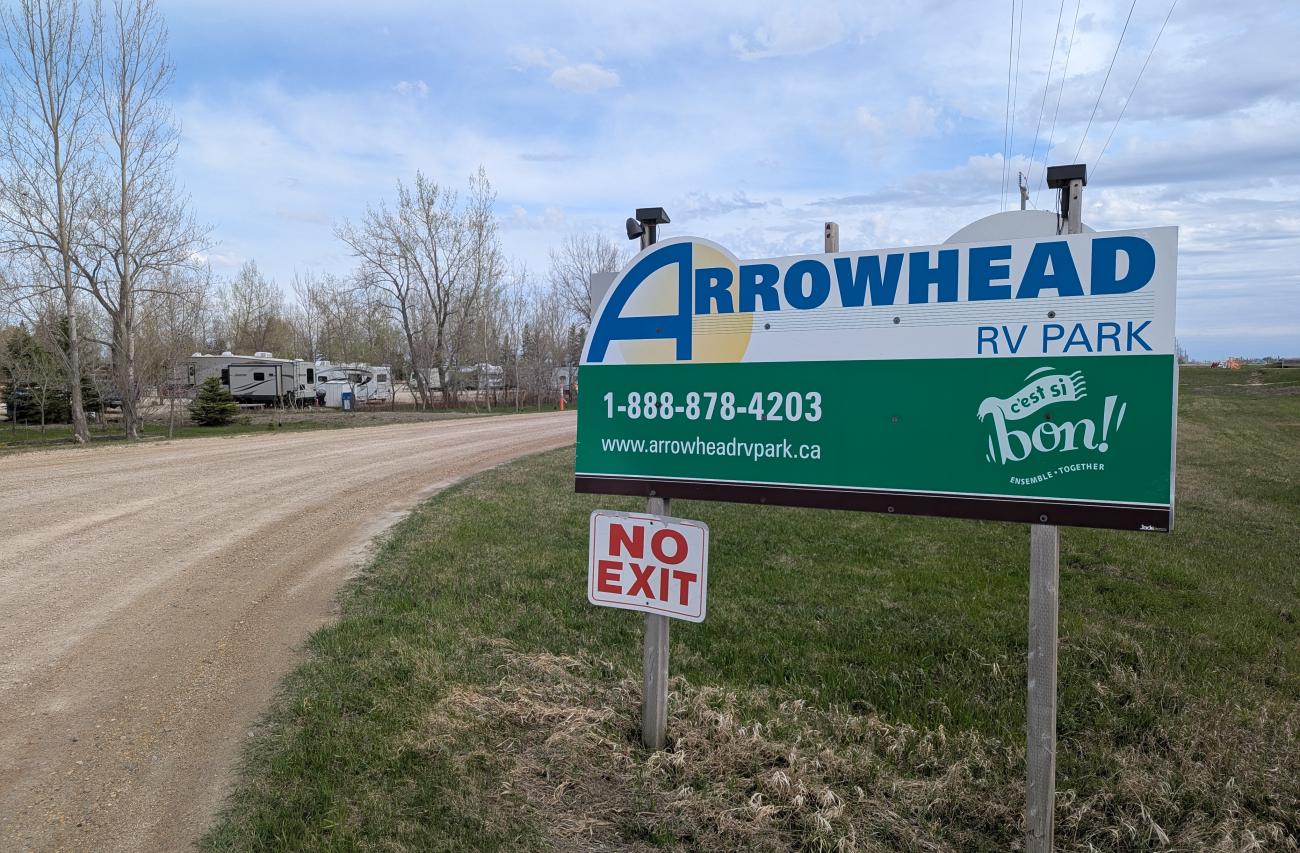
The owners of Arrowhead RV Park in Île-des-Chênes (IDC) are pushing for a significant change in the phase two plans for Oak River Meadow (ORM) before the new residential development get underway.
Lise Durand Bale and Bruce Bale sat before Ritchot’s council at the May 20 public meeting to appeal for assistance in ensuring that an appropriate buffer be created where ORM meets their property line. It’s a request the Bales say they’ve made with the developer on numerous occasions, to no avail.
“We fully support thoughtful growth in our community,” Lise Bale told council. “Our concern is that, without appropriate protections and transition measures, you are placing two very different land uses directly beside each other in a way that creates avoidable long-term conflict.”
The Bales’ attendance at Wednesday’s meeting was not by chance. On that night, Brennan Johnson of Landmark Planning and Design was in attendance alongside a representative from Terracon Development, there to request council’s approval for the first stage of road construction in ORM’s second phase.
Within the 90-acre section of land, the companies have designed what they believe to be a plan that meets the needs of the community while taking into consideration feedback gleaned from residents through their 2025 public engagement process.
For Johnson, this includes the Bales’ requests, as well as those of the homeowners living immediately east of the Arrowhead RV Park.
Because of those requests, he said, they’ll ensure that drainage concerns are met and fencing is installed along a portion of the one homeowners’ north and east perimeter. The proposed fence will them stop before the Bales’ north perimeter line, which is already populated by mature trees.
“We did contemplate multi-family abutting the Arrowhead RV Park for a few different reasons,” Johnson told council. “You can typically accommodate greater setbacks, there’s higher prescriptions for landscaping and buffering, and there’s different ways that you can orient parking.”
In the end, though, the designers opted to put 11 single-family dwellings along the stretch of shared property line, their backyards facing into the RV park. This was done, he noted, to reduce the number of people living in close proximity to the park for the sake of both the residents and RV park clients.
As well, Johnson says they considered the degree of buffer zone that would be adequate between the park and future ORM residents.
“The [single-family] lots themselves feature a depth of 145 feet,” Johnson says. “It’s the deepest being proposed throughout the entire phase two area. For connectivity, a proposed pathway network was designed to provide a connection to the Arrowhead RV Park so that, if they choose, their tenants or customers could access that pathway.”
Johnson indicated a willingness to negotiate a 25-foot buffer zone at the back of the residential lots which would prevent homeowners from constructing outbuildings in that area. Add to that the 20-foot setback for the house, there would be a total of 45 feet of buffer between the RV park and the neighbours’ houses.
Alternatively, he added, the developer would be prepared to allow the RM to assume ownership and management of the 25-foot buffer zone, to use as public reserve.
For the Bales, though, this plan falls short of the 50-foot buffer between property lines they’ve been requesting. As well, they anticipate the incorporation of more trees and an eight-foot fence there. Without these measures, Bale worries that the new neighbours will quickly be complaining about the noises and activities that are indicative of a business such as theirs.
“Future residents of Oak River Meadow will expect a more private and quiet residential environment,” said Bale. “Without proper separation, this interface is likely to generate ongoing conflicts and negatively affect both our guests’ experience and the quality of life of future residents.”
If the fence is too much of an ask, Bale suggested that the developer consider moving one of the development’s retention ponds to the buffer zone. Surrounding it with trees and shrubs, she said, it could serve as one of the development’s public green spaces.
For Johnson, this proposal presents problems since retention ponds don’t simply exist for aesthetic reasons. They provide strategic drainage functions within neighbourhoods. Greenspaces, too, are centralized within a development for easy access for all.
No other objectors to the phase two ORM plan came forward that night. One resident approached council encouraging them to reclaim the buffer zone as a public reserve space. In turn, she hoped they’d consider adding to the urban canopy by creating a forest on that land.
“The benefits to humans who directly or indirectly interact with trees—for aesthetic reasons, recreational reasons, and restorative value—are already being talked about in terms of mental health and wellness,” she said.
Here, the developer reminded those in attendance that hundreds of trees will be planted throughout the development, serving to significantly increase IDC’s existing urban canopy.
Two of the RM’s councillors, Jason Bodnarchuk and Janine Boulanger, noted that the Bales’ points deserve further consideration. Councillor Shane Pelletier requested that the final decision be tabled until June 17.
The Phase Two Plan
According to Johnson, phase two of the ORM plan is expected to add 351 new residential lots to the community. Of these, 165 are zoned for single-family dwellings and 182 for two-family side-by-sides. Ten and a half acres are reserved for greenspace.
On either side of Old Highway 59, space has been allocated for high-density housing as well as commercial, should the interest arise.
On the west side of Old Highway 59, and immediately across from Arrowhead RV Park, the developer says an education component is being considered.
“We have been in conversations with DSFM about the concept of a new school on potentially a 10-acre site,” the developer told council. “We would be willing to hold back a parcel for a period of five years to ensure that we can have dialogue for the acquisition of a school.”