

For immigrants landing in a new country, finding community is among the greatest imperatives. From there, all other steps can fall into place.
That’s the premise underlying Eastman Immigrant Services, founded in 1999 as a program through the Steinbach Chamber of Commerce. This non-profit currently has two offices in Steinbach.
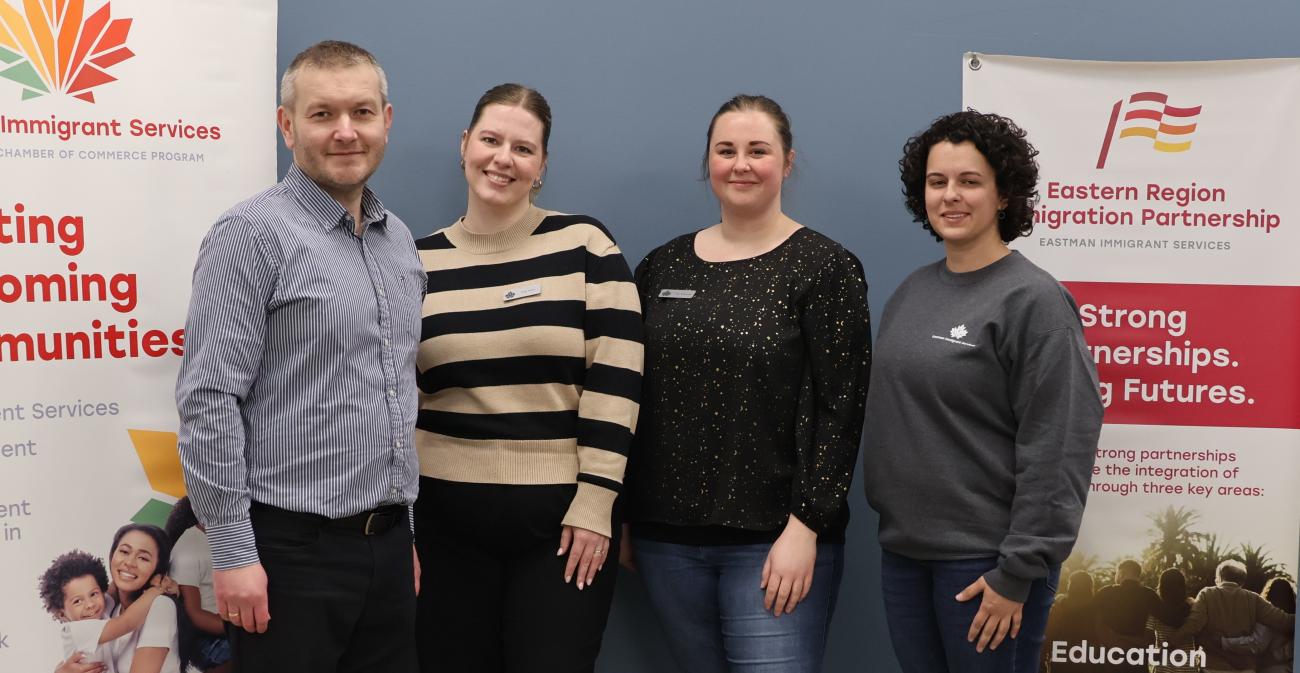
On March 10, four EIS employees stopped in Niverville to host an information evening. The goal is to build partnerships, foster connection, and make themselves more visible to anyone who might need their integration services.
“We are hugely [instrumental] to the area,” says Emily Schott, EIS program coordinator. “Especially now as things like racism are on the rise. Cultural differences that cause miscommunication can turn into misunderstandings. That’s where we come in. We can teach people how to integrate smoothly.”
EIS’s community information sessions are intended to draw in newcomers and longtime residents alike.
“Longtime residents are the key to integration,” Schott adds. “People who grew up here are exactly who we want to connect newcomers with, to build relationships and invite them into community. It’s so easy to isolate as an immigrant.”
This isn’t a fundraising initiative. EIS derives all its funding from the provincial and federal governments. They also don’t deal in the immigration process in any way. Their entire mandate is to help the already landed immigrant transition into the Canadian culture as seamlessly as possible.
Over the years, they’ve helped nearly 19,000 newcomers find homes, schools, and jobs. They offer settlement and employment services and English instruction through a variety of modes. They host invaluable programs like Settlement Workers in School (SWIS) and Home Instruction for Parents of Preschool Youngsters (HIPPY). As well, they run countless daytime and evening programs for adults and kids from their facility on Reimer Avenue.
The idea, Schott says, is to provide a one-stop shop for all new immigrant needs.
“In places like Winnipeg, you will often go to one place for your settlement needs, one place for your employment needs, and one place for your SWIS needs,” says Schott. “We try not to do that because transportation is a huge issue. In most rural areas, there’s no public transportation.”
EIS employs 25 workers, 95 percent of them immigrants themselves. Among them, at least 14 languages are fluently spoken. Behind them stand a team of dedicated volunteers, many of which have also benefited from EIS programs.
Sviatoslav (Slava) Baliuiev is the program coordinator for Eastern Region Immigration Partnership, a branch of EIS. Baliuiev and his family came to Manitoba from Ukraine in 2022.
Baliuiev’s role takes an indirect approach to newcomers. Working behind the scenes, he creates partnerships with government agencies, corporations, local politicians, and nonprofits to find ways to work together for the betterment of immigrant families. He is also the liaison between EIS and Immigration, Refugees and Citizenship Canada.
“We see the issues [in the system], but we can’t really do much about it,” Schott says. “Slava forms working groups and invites our staff to tell him [the problems] we are seeing. He’s then able to work outside of [our limitations] and have conversations with policymakers and politicians.”
Baliuiev also regularly meets with employers in the region, encouraging them to look to the immigrant community for employees. Many of these are agricultural companies relying on workers to fill jobs that aren’t the most desirable, like work in hog barns.
“In Blumenort, we have one of the biggest poultry companies,” Baliuiev says. “They have thousands of people working in this company and most of them are immigrants.”
Tiffany Froese and Emily Hildebrand are employed by SWIS and serve newcomer youth between the ages of five and 30, helping them integrate into the school system, getting them involved in after school programming, and assisting them in finding postsecondary study options.
“There’s a lot that goes on within the schools that parents don’t see or aren’t aware of,” says Froese. “Immigrant families are coming from abroad where the school system functions differently, so we go into the schools and actually spend time with the kids and see how they’re doing. We’re trying to get that inside perspective to relay back to the parents.”
SWIS also liaises with teachers and administrators to help them understand a child’s situation and needs. While school itself is a lesson in English instruction, SWIS workers ensure that kids get further instruction through a volunteer buddy program and after-school social clubs.
In a similar vein, EIS runs the HIPPY program for parents of preschoolers. These workers go into the home to provide young moms with English skills and social interaction. At the same time, they equip mothers with skills to help ready their young ones for school.
Baliuiev’s wife became a HIPPY worker after her youngest started school.
“For this year, they will allow 380,000 new immigrants for all of Canada,” Baliuiev says. “Previously it was 700,000, so almost 45 percent they cut back.”
The crew at EIS recognize the value of living in a country that welcomes newcomers. They’ve all experienced it, directly and indirectly, through the people they serve.
In fact, few Canadians can look back on their own familial past and not point to a generation that was thankful for the better life they found here. For this reason, Schott says it’s imperative that we all work to continue paying it forward.
“My parents grew up in Russia, but they were called Germans because they had a German passport,” Schott says. “When they went to Germany, they were called Russians. In Canada, we can all just be Canadian. It doesn’t matter where you came from. It doesn’t matter what language you speak. We are all Canadian.”