

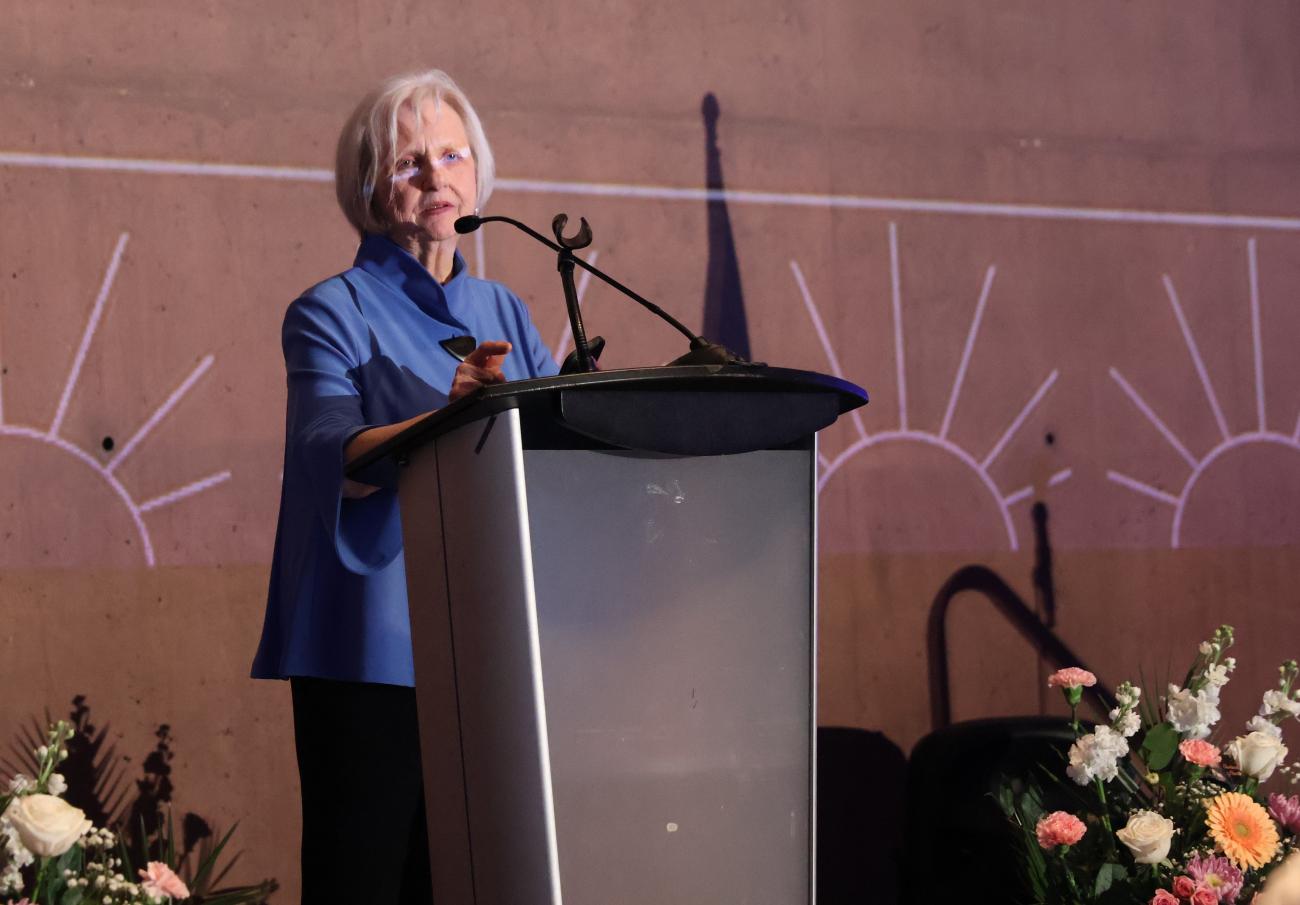
On March 12, hundreds of supporters filled the banquet hall of the Canadian Museum for Human Rights for the annual Joy Smith Foundation (JSF) fundraising gala.
The foundation, soon to be headquartered in Niverville, has become known for its work in creating awareness of human trafficking and rescuing and supporting its victims. In 2021, the foundation launched Canada’s first and only National Human Trafficking education centre.
Dignitaries included Minister of Justice Matt Wiebe, mayor of Winnipeg Scott Gillingham, MLAs Ron Schuler and Kelvin Goertzen, and U.S. consul Rebecca Molinoff. Also attending were members of the Winnipeg Police Service and a contingent of survivors.
Wiebe announced a donation by Manitoba Justice of nearly $18,000.
“Today marks human trafficking awareness day,” Wiebe said. “In the Legislature, we honoured and recognized the importance of raising awareness and reaffirming our commitment to addressing human trafficking through the ministerial statement. It serves to remind us that human trafficking is not a distant issue. It occurs throughout Manitoba and across the country.”
Another address was made by Gord Perrier, a former deputy chief of police in Winnipeg and current chair of the JSF board.
“I remember, more than 20 years ago, being involved in a police investigation where 16 people were being exploited and forced into labour at a drug production facility,” Perrier said. “They were locked in the basement, their shoes piled on the other side of a locked door. Identification and passports were held by another individual and they were threatened with harm to themselves and their families if they tried to leave.”
It was a time, he said, before adequate laws existed in Manitoba to intervene. Thanks to the JSF, stricter policy and law enforcement now exists across the nation.
“Every survivor deserves more than escape,” Perrier added. “They deserve healing, dignity, and the chance to rebuild their lives. We have the opportunity to make that happen.”
Janet Campbell, the organization’s president and CEO, reminded the crowd of the organization’s humble beginnings and Joy Smith’s unwavering commitment to creating change in the judicial system.
“[She chose] to speak out about human trafficking at a time when very few people were talking about it,” Campbell said. “That decision set in motion a journey that helped change the criminal code in Canada, establish awareness across the country, and contribute to the creation of Canada’s national action plan.”
Campbell also acknowledged the wide network of supporters, including healthcare professionals, law enforcement partners, and educators who make young people aware of the issue of human trafficking.
The Air Canada Foundation is also among the JSF’s corporate supporters.
Proceeds from the fundraising evening will both aid the foundation in day-to-day work but bring it closer to their latest dream of constructing an education campus on an acreage outside Niverville.
“At this dedicated campus, survivors will find healing and stability, professionals will learn how to recognize and prevent trafficking, and communities will come together to protect the most vulnerable,” said Campbell. “It’s a place that will be built on hope, partnership, and the belief that lasting change happens when people choose to stand together.”
The evening’s keynote speaker was Meagan Walker, former executive director of the London Abused Women’s Centre, who was instrumental in guiding more than 1,300 exploited women and girls to safety.
“Traffickers don’t like people like Joy,” Walker said. “They don’t like her, of course, because she is so effective in disrupting the flow of women and girls into their stables.”
The term stable, she noted, is common among traffickers. It reduces the women in their control to work animals.
For 35 years, Walker listened to stories told by women and girls who tried to escape the sex trade. These were simultaneously the most rewarding and traumatic parts of her life.
“I have also supported their families as they longed to know whether their children were alive or dead,” Walker said. “Imagine being forced to go to a website advertising sexual services to search for some indication that their children were alive. The traffickers owned the girls and, by extension, owned the parents too.”
Many of the girls lured into trafficking, she said, are between 13 and 15 years of age.
One of those survivors, Alicia Taylor, was invited to perform a hoop-dances at the gala. Sold into the sex trade as a child, the team at JSF helped her to rebuild her life.
“I may never forget, but I am no longer alone,” Taylor said. “The foundation were the first people I felt ever understood and listened to me. I will never forget them saying, ‘I believe everything that you’re telling me.’ This was an essential part in my healing.”